After Snow seeks to understand the ski resort as a human-designed landscape on the brink of ecological and cultural collapse. This research uses design to reimagine futures for the alpine ecologies — not as a privatized, extractive enclave, but as public terrain.
{{ s.name }}
{{ v.name }}
Framing the Problem
It probably won't come as a surprise that winter is fading. In the Alps (pictured above), the snow-inundated winters that fuel a world-renowned outdoor industry are growing scarce, leaving alpine landscapes that typically accumulate six to seven feet seasonally barren. In the not-so-distant future, winter as we know it may cease to exist: the landscape conditions that materially define skiing are unraveling. They are melting, and at the same time being reengineered to simulate what no longer falls on its own.
Telluride was selected as the primary case for the research of After Snow, breaking the issues down into four scales: Climate, the disappearing raw material; Cultural, the question of who ends up holding the mountain as climate risk mounts; Landscape, the physical response of regraded terrain, cleared forest, and diverted water; and Alpine Abandonment, what is left behind when a resort closes. Read together, they describe a designed landscape whose logic is failing as the climate it was built for warms. After Snow designs for the long range to avoid the conventional path of abandonment, already witnessed in volume across the European Alps and the American Northeast.
Climate
Climate change is causing measurably less snow, and Telluride is far from alone in it. Across the Rockies, the Sierra Nevada and the Alps, snowfall is becoming erratic and insufficient. A recent projection shows that by 2100, nearly every major mountain region will lose measurable snowpack, and 13% of resorts will have no snow at all. Expanding into higher elevations has become the standard response by resorts globally, chasing colder microclimates to buy time in the never-ending battle against climate change.
But vertical migration upward is finite. The mountain ends.

Cultural
Ski resorts are consolidating into corporate megaliths in response to climate change and deregulation. Mega-resort monopolies like Vail Resorts, POWDR, and Alterra now dominate the global ski market — a strategy of consolidation that protects profits from climate volatility while doubling down on snowmaking infrastructure. Resorts that experience several consecutive low-snow years are likely to be bought out by these holding companies, further concentrating the ski landscape into fewer owner hands.
Landscape
Cold Regions Science and Technology — research paper → Field experiments on living snow fences — Annals of Glaciology → Artificial snow is changing alpine soil. In the face of climate limits, the industry has leaned into increasingly technical solutions — snowmaking, once a stopgap, is now standard. It requires an extensive network of underground pipes, pumping stations, electrical infrastructure, and storage reservoirs, plus massive water withdrawals. The snow it produces is five times denser than natural snow, slower to melt, and settles onto ecologically devoid soils. Combined with grooming machinery, it compacts soil, disrupts plant succession, and delays spring regrowth.
Seen from above, the argument makes itself. A ski resort is as “designed” a human-contrived landscape as the more recognizable works of landscape architecture like parks, gardens, and urban plazas. Regraded runs, snowmaking ponds, lift lines, service roads and alpine real estate schemes are all human work, built by people for people. The ski mountain is one of the most impressive works of artifice of our time, and yet it is still described as an escape into “pristine nature.”
Alpine Abandonment

France is roughly a generation ahead of the American Rockies on the closure curve, which makes it the clearest available picture of what an unplanned retreat leaves on the ground. Closure is not the end of the infrastructure. When a resort stops running, the machinery stays: towers, cable, haul rope, pylon footings. And beneath it, a century's worth of industrial and forestry leftovers: barbed wire, fencing, old equipment, slowly settling into some of the wildest land Europe has left.
113
3,000+
The case of the French Alps supports After Snow's argument for designing an exit strategy.
The Guardian — as the snow retreats, France's ski lifts are left standing →Could a community buy back its own mountain?
In the last week of December 2025, Telluride's mayor pro-tem Meehan Fee and Mountain Village mayor Marti Prohaska flew to California and offered owner Chuck Horning $127.5 million for 51% of Telluride Ski and Golf, backed by community-focused investors — roughly thirteen times the resort's estimated annual earnings, against a mountain he bought in 2005 for about $45 million. The deal looked live until the draft contract surfaced publicly and the ski company shut it down.
Telluride's ski area is a private business operating on a largely public mountain. The terrain is National Forest, held under a federal Special Use Permit that runs to February 2044. The snow is made partly with the town of Telluride's water and the rest with Mountain Village's. The gondola that connects the two towns, was built and continues to be supported by public funds. The people who run Telluride, for the longest time, have been able to live in Telluride. This is now a changing reality, as exorbitant real estate prices and a rental market geared toward high-value short-term tourist stays push long-term residents out. Everything about the mountain is already collective except the resort's decision-making.
The last two winters put a price on that arrangement. A resort closed at Christmas over patrol wages. A water pricing dispute settled only after the resort threatened not to make snow. An owner who did not show up to his own council update. None of those are snow problems; they are failures of governance, and a community with no seat at the table cannot fix any of them.
Public and community ownership is not hypothetical here, it has been done before. Ski areas already operate as municipal departments, nonprofits, and cooperatives across North America, and a number of that size sits within reach of the same public financing tools towns routinely use for water systems, transit, and land. Acquisition would let the valley do what no private owner has an incentive to do: stop leaning on extractive real-estate development to prop up a profit model that a shortening winter has already destabilized, and manage the mountain for the two centuries after skiing rather than its current year-to-year trajectory.


Selected Plates

Telluride, Colorado
Telluride is nestled in a high-altitude box canyon in the southwest corner of the state. With just 2,700 permanent residents, its dramatic setting and global destination status often obscure its layered history of mineral extraction. Once a fertile hunting ground stewarded by the Ute tribe, it was colonized in 1875 in the name of gold.
Even its very name — derived from tellurium, a metalloid found attached to gold — signals that Telluride was built on speculative value. And when the mines finally closed in the 1960s due to failing markets and supply, snow became the new gold.
Miners turned venture capitalists converted ranch and Forest Service land into navigable terrain, initiating Telluride's transformation into a winter destination. While it was not originally designed for the ultra-wealthy, the unchecked expansion of real estate, now the primary profit model for most ski resorts, slowly reshaped the town into the exclusive and often unlivable enclave it is today.
Telluride's “transformation from dirt streets to designer stores”1 was only possible by the boom and doom of the land practices that came before. Though the resort operates largely on public land under a 40-year Special Use Permit from the U.S. Forest Service, issued in 2004 and set to expire in 2044, its day-to-day experience is defined by intense privatization, a landscape “governed by technical systems rather than ecological processes,”2 where ownership and extraction are prioritized over care and repair.


Snow is disappearing.
It probably won't come as a surprise that winter is fading. In the Alps, the snow-inundated winters that fuel a world-renowned outdoor industry are growing scarce, leaving alpine landscapes that typically accumulate six to seven feet seasonally barren. Skiing is a multibillion-dollar industry across the globe, and the raw material it is built on is going away.
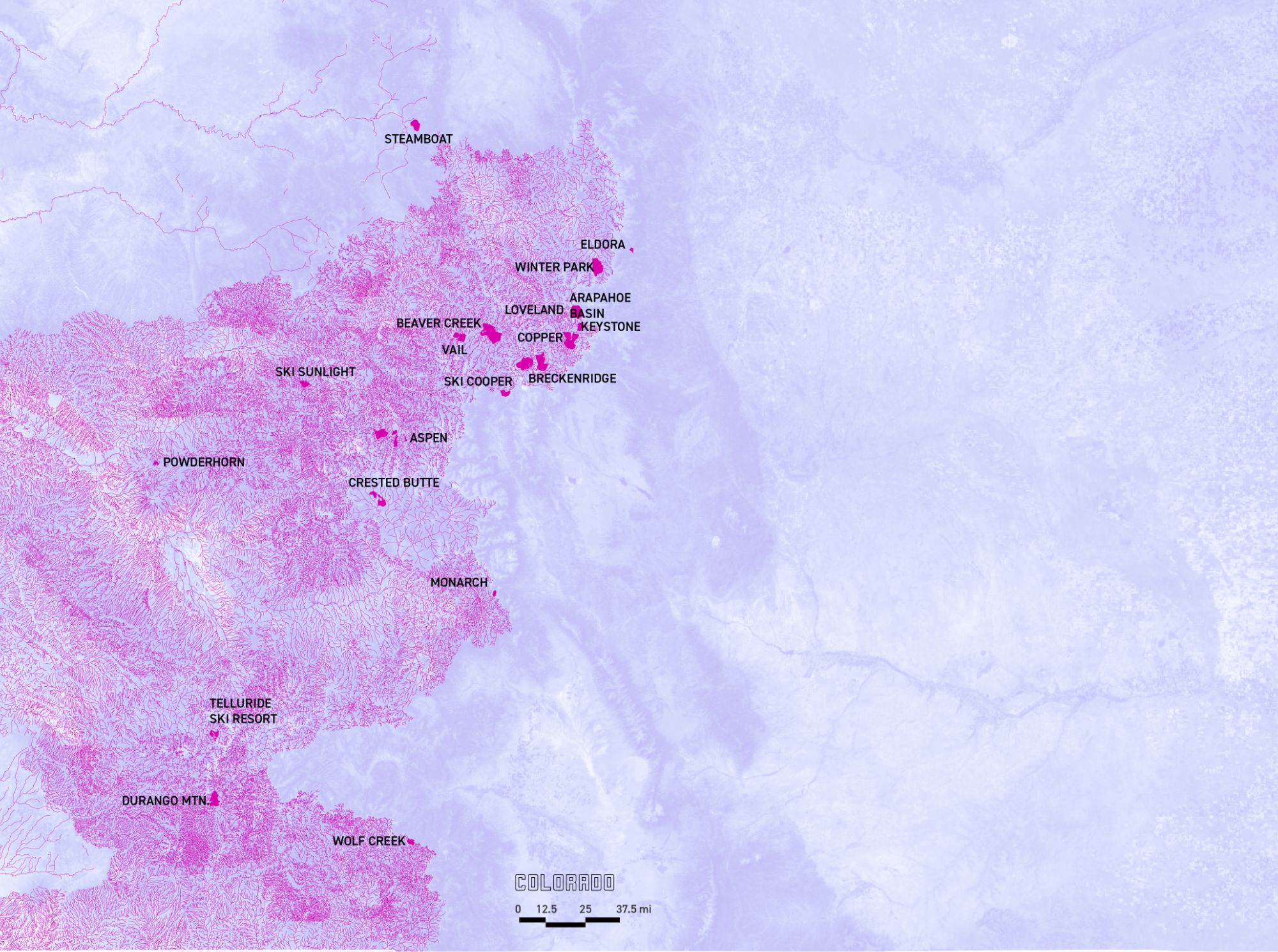
The loss is not evenly distributed. Some ranges are being hit harder, and faster, than others. A recent projection shows that by 2100 nearly every major mountain region will lose measurable snowpack — 13% of resorts will have no snow at all. Telluride, Colorado is located in the Southern Rockies and will face one of the most extreme losses of snowpack and winter moisture within this mountain region, exposing it to a range of environmental issues beyond fewer skiable days, like forest fires, drought, and more invasive species.
Expanding into higher elevations has become the standard response by resorts globally, chasing colder microclimates to buy time in the never-ending battle against climate change.
But vertical migration upward is finite. The mountain ends.

Local Climate Impacts — Telluride, Colorado
For a place so tied to its winter economy, Telluride is experiencing some of the most intense measurable effects of climate change in Colorado. Snow arrives later, melts earlier, and fluctuates wildly in quality and volume. What was once a four-month season is now compressed, unpredictable, and often reliant on artificial coverage. Average skiable days have declined by nearly 20% over the past three decades.
The satellite record below compares the extremes between the 2018 and 2023 winter seasons. The pairs below show the same month five years apart with the permit boundary of the resort overlayed in white.
Fabricating Winter
Snowmaking is the process of atomizing pressurized water into fine droplets and propelling them into cold air with compressed air or high-powered fans. As the droplets fall, they lose heat to evaporation and the surrounding air, freezing into small, dense ice grains before they reach the ground. Production depends on the wet-bulb temperature, a combined measure of air temperature and humidity, which typically has to be around 27°F (−3°C) or colder*. It was once considered a stopgap, but now is the gold standard and a necessary crutch in the skiing industry. It requires an extensive network of underground pipes, pumping stations, electrical infrastructure, and storage reservoirs. Not to mention massive water withdrawals from the already strained Colorado River Basin. (*Snowmaking technology now allows for above-freezing production.)
Artificial snow is silently impacting alpine ecologies. This snow that resorts now “produce” is up to five times denser than natural snow, contributing to its heavy compressive force on alpine soils and slower to melt in the spring runoff season. In Davos, Switzerland, Christian Rixen, Veronika Stoeckli and Walter Ammann found that Cold Regions Science and Technology — research paper → Field experiments on living snow fences — Annals of Glaciology → where artificial snow is applied, snowmelt may be four weeks later than at sites with natural snow. And because fake snow requires maintenance, snowcat "groomers", the terrain below has to be cleared and regraded to an even slope. This compounds compaction instilling a permanent change to the ground itself.
The machinery is older than the crisis it now props up. The first commercial snowmaking machine was built in 1950 by three engineers — Art Hunt, Dave Richey, and Wayne Pierce — who rigged a paint-spray compressor, a nozzle, and a garden hose into a snow cannon, blowing water droplets into freezing air. The principle came from Canadian researcher Ray Ringer, who had accidentally made snow crystals in the early 1940s while studying rime ice on jet engines. The Hunt-Richey-Pierce design was patented in 1954 and first used commercially at Grossinger's Catskill Resort in 1952; by the 1980 Lake Placid Games, an Olympics ran on manufactured snow for the first time. The lance towers standing on Telluride's runs today descend directly from this technology.
Infrastructural Expansion
Snowmaking is only a small part of the visible infrastructures of skiing. Keeping just one run open also takes lift towers, buried water pipes and air lines, pump houses and reservoirs, transformers, service roads, and a fleet of groomers with the onsite diesel storage to run them nightly.

Consolidation
A small independent ski resort operator cannot survive several back-to-back seasons of low or no snowpack. Many independent resorts have folded into a larger corporate portfolio, like Vail Resorts or Alterra. These corporations spread their gains and losses across geographically and climatically diverse mountain ranges to maintain profitability. Mega-resort monopolies like Vail Resorts, POWDR, and Alterra now dominate the global market; nearly 40% of North America's ski areas have been bought out, largely within the last ten years.
The corporatization of skiing has made the sport financially inaccessible due to its transition to an all-or-none season pass model, exploded real-estate speculation in small isolated ski towns like Telluride, and the widespread expansion of artificial snowmaking.
“Telluride is at risk of acquisition: a few consecutive bad snow years could resituate it from its current individual-owner model to just another asset in a corporate skiing portfolio.”
Who Owns What
Skiing & Telluride, Through the Archive
Historical Layers


On the table
Moving Historical Section
Research methods
Alongside archival research, the project drew on primary sources: interviews and conversations with the people who run, study, and live with this mountain.
Acknowledgements
See Forever
See Forever is the spine of the Telluride Ski Resort. It is a ridge run that funnels skiers down from the top of Lift 15, passing Lifts 14, 6, 9 and 7, before arriving at the midway point of the gondola and onwards into the town of Telluride or Mountain Village. It is also the resort's most heavily engineered ground: the trail sits inside a braid of snowmaking mains, hydrants and grooming corridors, drawn in the map below.
The three strategies that follow: Frame, Filter, & Foil are tested along this line.


Design Framework
Click the sections below to expand each design strategy
{{ fs.name }}

Landscape Design Research


Ecology and landforming
{{ detailTitle }}
{{ detailBody }}
Models
{{ modelTitle }}
{{ modelBody }}


After Snow Field Guide


Design Iterations

Visual References
Fences that read a landscape by crossing it, and the archive of how a ski resort gets drawn before it gets built.


Advocacy





After Snow: The Case for an Alpine Public
A presentation on the future of skiing followed by a panel on "the cost of doing nothing," featuring local recreation stakeholders and EcoAction Partners on our current climate.
Cases
Thanks to the Peter Walker & Partners Fellowship, this research is continuing beyond After Snow. The fellowship is funding a set of comparative cases alongside Telluride, Colorado. The goal is strengthening the argument that alpine landscapes are shifting quietly and unevenly across the globe, and surfacing what communities in each place are doing to slow that retreat.
Snow Farming
Sun Peaks, BC
Across the Alps, resorts and glacier operators now blanket snowfields in reflective geotextiles each summer, slowing melt to protect both glacier ice and the artificial snow base beneath it. Unlike Telluride's snowmaking infrastructure, which manufactures winter after the fact, blanketing tries to preserve what's already there. A more literal, physical act of stewardship, but one still built on continuous capital investment rather than systemic change. As this practice expands to North America, it offers an instructive counterpoint to After Snow's proposed strategies: can conservation-by-preservation coexist with, or does it forestall, the deeper redesign the thesis calls for?
Aspen, CO
Aspen Skiing Company contracted Snow Secure to collect and preserve snow from the 2025–26 winter season. Crews piled up the leftover snow, mostly from the terrain park, and put it under Snow Secure's insulating cover. Aspen estimates that up to 85% of the snow is preserved into the next season. Aspen Skiing Company is family-owned (though its owners, the Crown family, co-founded Alterra Mountain Company with KSL Capital Partners) and is one of the most outspoken climate voices in the industry, which makes it a revealing neighbor to Telluride. Aspen has commodified its stored snow and now “guarantees opening day.” This case builds on Sun Peaks and Davos in asking whether snow storage is a real benefit or just a way to prolong the inevitable.
Davos, Switzerland
Davos stores a mound of snow through the summer on the Flüela Pass road and reopens a four-kilometer cross-country trail by the end of October, weeks before winter arrives. It is the clearest working example of treating snow as a stored resource rather than a seasonal delivery. Mimicking a reservoir, and almost managed exactly the same as water.
At twenty to thirty feet, the mound is sealed. The traditional method is a twelve-inch layer of wood chips or sawdust — cheap, excellent thermal insulation.
Premium operations use multi-layered technical fabric: a reflective white outer face bouncing solar radiation, a porous inner core letting evaporating moisture escape while keeping warm summer rain out of the pack.
For After Snow, snow farming is the most honest version of mitigation on offer: it accepts scarcity and manages a shrinking resource deliberately, rather than manufacturing an unlimited supply on demand. It also concedes the argument — a season that has to be stored over the summer is no longer a climate, it is an inventory.
Passive Drift Harvesting
Banff Sunshine, AB
“At Banff Sunshine Village in Alberta, ‘snow farming,’ says Kendra Scurfield, vice president of marketing brand and communications, ‘is a great way to catch what you get from Mother Nature and spread it around.’ Spanning 3,300 acres across three mountains, the area’s ski terrain relies solely on farmed snow. ‘We don’t have a water source near us, so we’ve had to rely on snow farming to get our terrain open,’ she says.”
Jennifer Cole, Reasons to be Cheerful, Mar. 28, 2025
Retooling Alpine Infrastructures
Steamboat Springs, CO
In Steamboat Springs, the resort has begun running snowguns outside of ski season to lay down protective moisture ahead of wildfire fronts. They are repurposing the same machines critiqued in After Snow as an artifact of dissonant adaptation. This case examines the logic in reverse: instead of retooling snowmaking for ecological repair, resorts are retooling it for asset protection. It's a useful test of the thesis's core claim — that snowmaking infrastructure, once built, can be redirected toward public or ecological ends rather than purely private ones.
Alternate Skiing Economies
Arctic Valley, AK
Alaska's alpine terrain sits inside a different ownership logic than Telluride's private resort model: vast tracts of ski-adjacent land remain under military jurisdiction, layered with Indigenous claims and federal land management. Where After Snow argues for prying open a privatized mountain into public commons, Alaska's militarized zones raise the inverse question — what happens when access is foreclosed not by capital, but by defense infrastructure? The case traces how national security designations restrict recreation, complicate stewardship, and produce their own version of an inaccessible alpine landscape.
Resources
{{ bookTitle }}
{{ bookDesc }}

Contact

About
Cory Page holds a dual master's degree in landscape architecture and urban planning from the Harvard Graduate School of Design (GSD). His work examines shifting landscapes shaped by climate volatility, material flows, and evolving cultural practices — using snow as an entry point into broader questions of environmental instability, resource management, and design's role in adaptation.
As the 2025 Peter Walker & Partners Fellow at the GSD, Cory's research builds on his thesis, After Snow, which reimagines the ski resort as a public terrain for ecological and spatial remediation. Set in his hometown of Telluride, Colorado, the work extends toward comparative research in the Alps, Andes, and arid urban regions of Mexico.
Cory is a Lead Designer at Polistudio, an interdisciplinary planning and design practice in Mexico City focused on adaptive reuse and urban regeneration.